


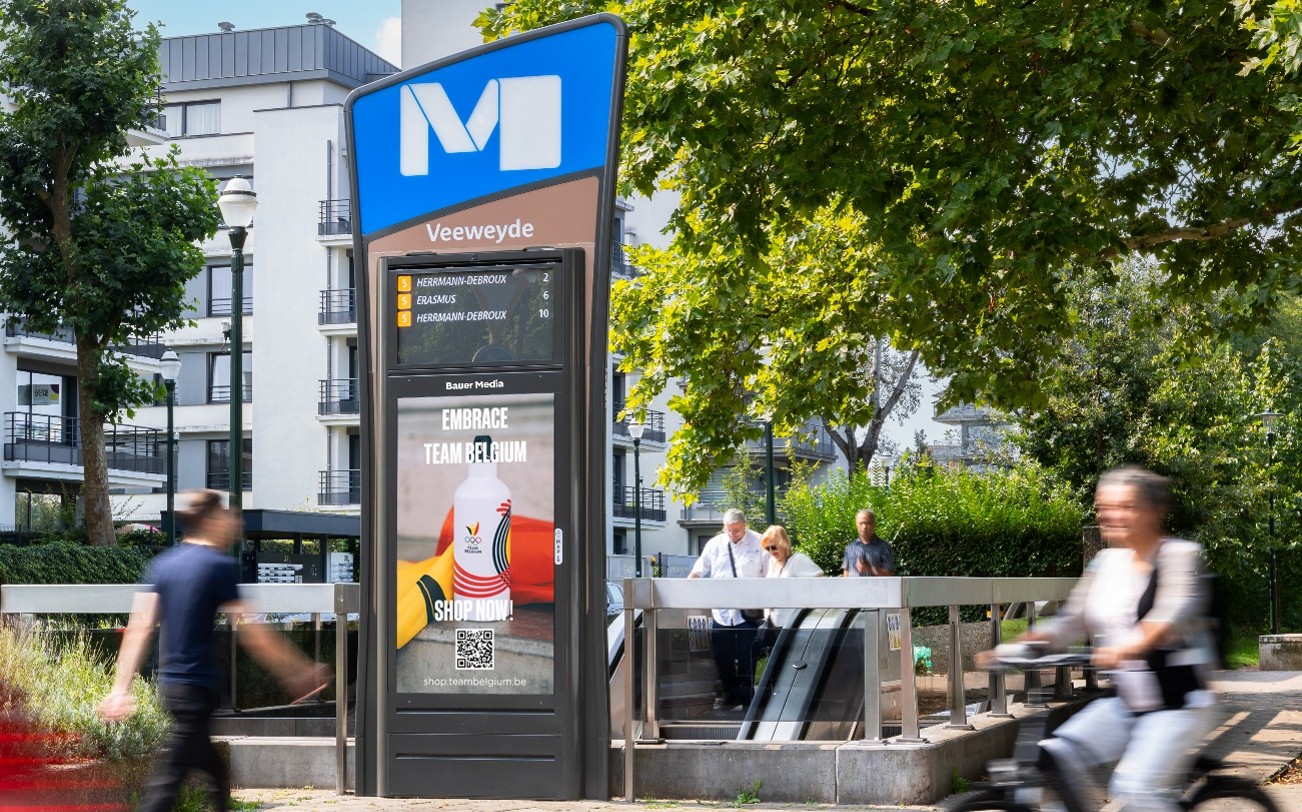
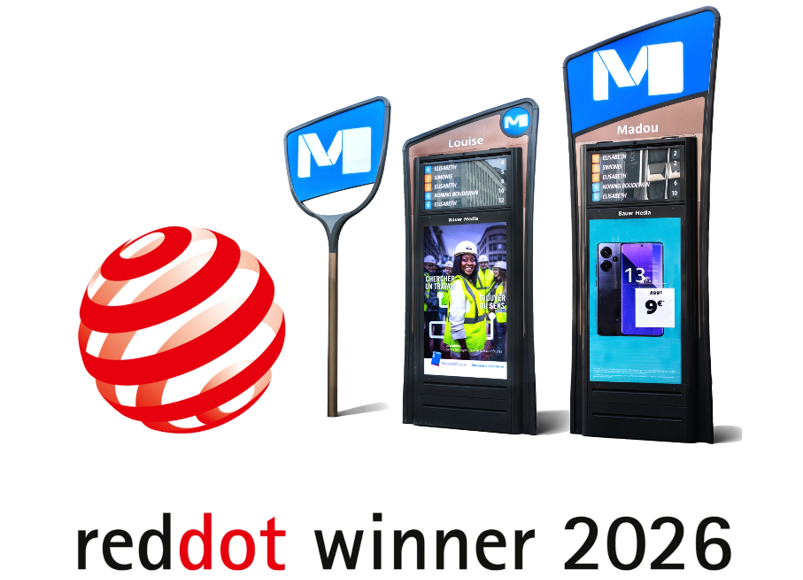
How can design make a city more intuitive, welcoming, and sustainable? This is the question answered by the Brussels Metro Totem Network, developed for STIB by Yellow Window and deployed by Bauer Media Outdoor. Presented yesterday at the official Red Dot Design Awards ceremony, the project received a Red Dot Award: Product Design 2026, one of the highest international honours in design. This recognition rewards far more than just an object: it celebrates a new way of thinking about street furniture as a genuine service to the public.
Design at the service of mobility
Every day, hundreds of thousands of passengers pass through the entrances of the Brussels metro. Behind this routine action lies a major challenge: enabling everyone to find their way quickly, access reliable information, and navigate the urban space naturally.
Deployed across all 69 metro stations, the network of 130 interactive digital totems meets this objective by combining real-time waiting times, route planning, shared mobility services, and instantly recognizable signage onto a single platform. More than just a piece of equipment, it becomes a landmark that guides the journeys of millions of users throughout the year.
A forward-looking Brussels identity
Inspired by Brussels Art Nouveau, the totems reinterpret the capital's architectural heritage through a contemporary lens, balancing local identity, legibility, and industrial constraints. This approach continues the work of the studio founded by Axel Enthoven, which has already been recognized with two Red Dot Design Awards for STIB's TNG tram and M7 metro.
Designing infrastructure built to last
The project also demonstrates that urban performance and environmental responsibility can go hand in hand. Intelligent energy management, recycled materials, and a modular design that facilitates maintenance and longevity: every design choice aims to reduce the environmental footprint while ensuring a sustainable service.
This shared vision, driven by STIB, Yellow Window, and Bauer Media Outdoor, proves that design is not just a matter of aesthetics. It is a concrete lever for improving user experience, strengthening a city's identity, and supporting new forms of mobility.
A recognition that opens new perspectives
The Red Dot Award provides international recognition for this approach. However, beyond the trophy, it confirms the role that design can play in transforming public infrastructure: making cities more legible, more connected and more human-centric.

No items found.
No items found.